
H. H. Holmes
American con artist and murderer active 1891–1894.

advertisers of Tulane Greenie football program · Public domain
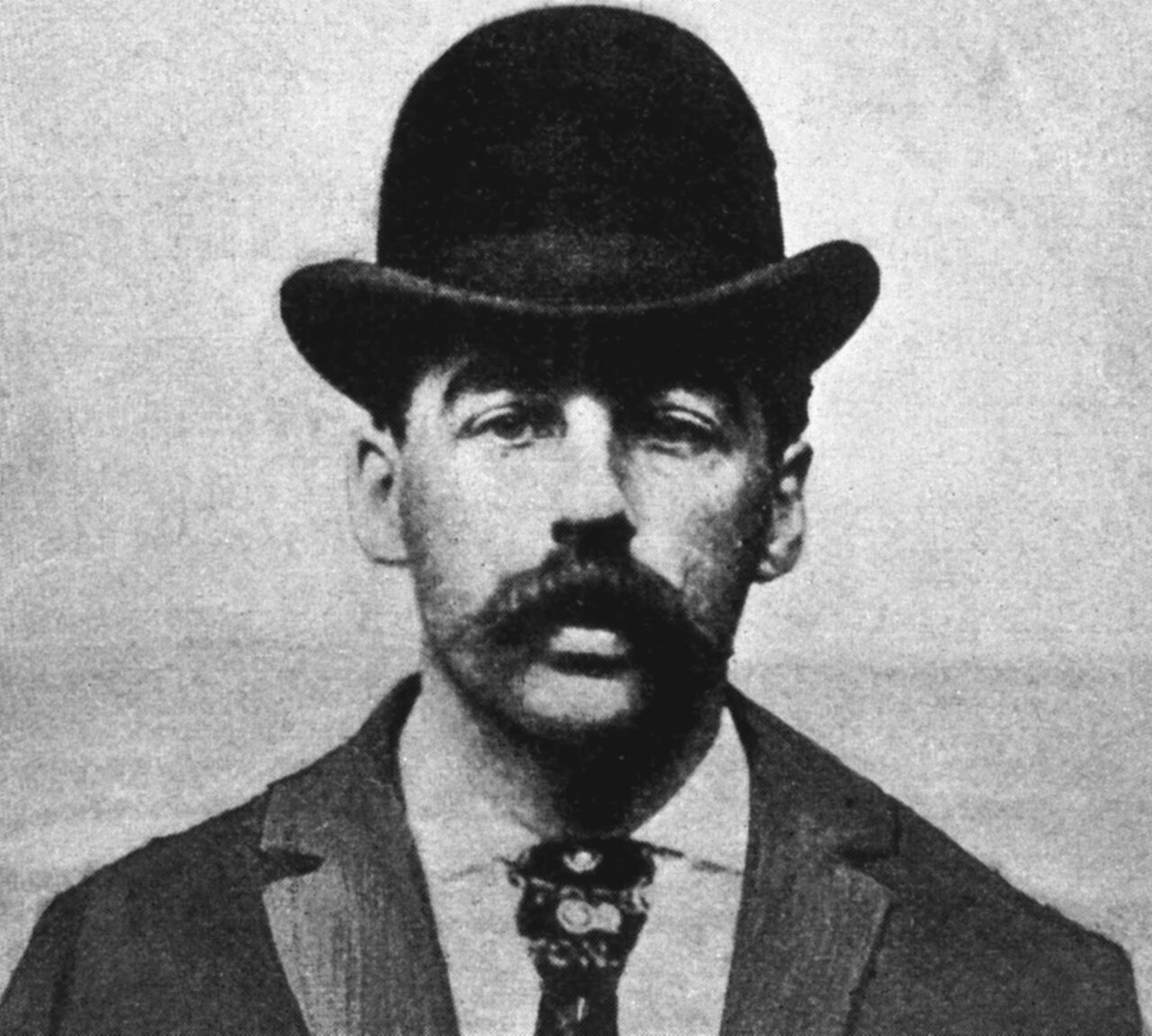
Herman Webster Mudgett (May 16, 1861 – May 7, 1896), better known as Dr. Henry Howard Holmes or H. H. Holmes, was an American con artist and murderer active between 1891 and 1894. By the time of his execution in 1896, Holmes had engaged in a lengthy criminal career that included insurance fraud, forgery, swindling, three or four bigamous marriages, horse theft and murder. He committed his most notorious crimes in Chicago around the time of the World's Columbian Exposition in 1893. Holmes was convicted and sentenced to death for the murder of Benjamin Pitezel, his accomplice in several of his cons. He confessed to twenty-seven murders, including some of people who were verifiably still alive. Much of the lore attached to Holmes, including details about his so-called 'Murder Castle,' is considered exaggerated or fabricated for sensationalistic tabloid pieces.
- born
- May 16, 1861, Gilmanton, New Hampshire
- died
- May 7, 1896 (executed by hanging)
- field
- Con artist, murderer
- nationality
- American
- known_for
- Crimes during the 1893 World's Columbian Exposition; alleged 'Murder Castle'; co
Verified Timeline
Lore & Background
Holmes was born as Herman Webster Mudgett on May 16, 1861, in Gilmanton, New Hampshire, the third child of Levi Horton Mudgett and Theodate Page Price. He had two older siblings, Ellen and Arthur, and one younger brother, Henry. As an adolescent, Holmes attended Phillips Exeter Academy before graduating high school with honors from Gilmanton Academy at age 16. His parents were devout Methodists; his father was a heavy drinker who cruelly beat his children. Holmes faced bullying by classmates due to his academic capabilities. In one incident, he was forced to stand in front of a human skeleton and put its hands on his face. Initially terrified, he later found the experience intriguing and claimed it helped him overcome his worries, developing an obsession with death and beginning to dissect animals. In 1879, he enrolled at the University of Vermont for one year. In 1882 he transferred to the University of Michigan's Department of Medicine and Surgery, graduating in June 1884. While enrolled, he worked in the anatomy lab under Professor William James Herdman, and the two were said to have engaged in body snatching to supply medical cadavers. Holmes later admitted to using cadavers to defraud life insurance companies several times in college. After moving to Chicago in August 1886, he changed his name to 'Henry Howard Holmes' to avoid exposure by victims of his previous scams.
Reader's Guide
H. H. Holmes remains a figure of enduring fascination, but much of the lore surrounding him is unreliable. The 'Murder Castle' stories—secret torture chambers, trapdoors, gas chambers, a basement crematorium—were sensationalized by yellow journalism and have no basis in official findings. The building on W. 63rd Street was used for business, and its irregular architecture was a product of fraud, not designed to fulfill violent fantasies. Holmes's own confessions are contradictory; he initially claimed innocence, then later said he was possessed by Satan. He admitted to murders that never happened—for example, he claimed to have killed Dr. Robert Leacock in 1886, but Leacock died on October 5, 1889, in Watford, Ontario, Canada. Author Adam Selzer notes that the murders Holmes can be connected to had clear practical motives: 'someone knew too much, or was getting in his way, and couldn't be trusted. The murders weren't simply for love of bloodshed but a necessary part of furthering his swindling operation and protecting his lifestyle.' Since the 1990s, Holmes has been labeled the first U.S. serial killer, but this label is debated because his crimes were not a series of similar acts driven by psychological compulsion. His legacy is a cautionary tale about the intersection of fraud, violence, and media exaggeration.
Did You Know?
- Holmes confessed to twenty-seven murders, but some of those people were verifiably still alive.
- The 'Murder Castle' on W. 63rd Street was used for business, and its odd layout was a product of fraud, not murder.
- Holmes claimed to have killed Dr. Robert Leacock in 1886, but Leacock died on October 5, 1889, in Watford, Ontario, Canada.
- Author Adam Selzer argues that Holmes's murders had practical motives—eliminating people who knew too much or got in his way—rather than being driven by a psychological urge for bloodshed.
- Holmes was convicted and sentenced to death for the murder of Benjamin Pitezel, his accomplice in several cons.
Early Life and the Seeds of Obsession
Herman Webster Mudgett was born on May 16, 1861, in Gilmanton, New Hampshire, the third child of Levi Horton Mudgett and Theodate Page Price, both descended from among the earliest English settlers in the region. His household was shaped by his parents' devout Methodist faith and his father's violent temper, which reportedly included cruel beatings of the children. Academically gifted, young Mudgett attended Phillips Exeter Academy and graduated high school with honors at just sixteen, yet his brilliance made him a target for bullying. One haunting episode involved classmates forcing him to stand before a human skeleton and place its hands against his own face. What began as terror became fascination, and he later credited that moment with helping him conquer his anxieties. The encounter ignited a lifelong preoccupation with death that led him to dissect animals. His education continued at the University of Vermont for a year before he transferred to the University of Michigan's medical department in 1882, where he worked in the anatomy lab under Professor William James Herdman. Despite mediocre grades, he graduated in 1884, and he later admitted to using cadavers to defraud life insurance companies during his college years.
The Swindling Machine in Chicago
After arriving in Chicago in August 1886 under the new name Henry Howard Holmes, the former Mudgett quickly embedded himself in the city's commercial life. He took a job at a drugstore on the northwest corner of South Wallace Avenue and W. 63rd Street in the Englewood neighborhood, where owner Elizabeth Holton hired him. His diligence earned him the opportunity to purchase the store outright. He then bought an empty lot across the street and, beginning in 1887, commissioned a two-story mixed-use building with apartments above and retail spaces, including a new drugstore, below. When he refused to pay the architects and the steel company Aetna Iron and Steel, they took him to court. Beyond the real-estate maneuvering, Holmes ran a sprawling criminal enterprise spanning insurance fraud, forgery, swindling, horse theft, and three or four bigamous marriages. Author Adam Selzer has observed that the killings connected to Holmes generally served a practical purpose: silencing someone who knew too much, removing an obstacle, or protecting the machinery of his cons. The murders were not born of a desire for bloodshed but functioned as necessary components of sustaining his fraudulent lifestyle.
The Murder Castle: Myth Versus Record
The most enduring image attached to Holmes is the so-called Murder Castle, a three-story structure he commissioned on W. 63rd Street in Chicago. In popular imagination, the building has become a labyrinth of hidden rooms and torture devices, with some sensational accounts inflating his body count to as many as 133 victims. Yet official findings paint a far more mundane picture. The W. 63rd Street property was used for legitimate business purposes, and the building's irregular architecture is attributed to the practical demands of fraud rather than to any design intended to facilitate violence. The gap between reality and legend was widened by two converging forces: an ineffective police investigation that left critical questions unanswered, and the hyperbolic yellow journalism of the 1890s, which prioritized spectacle over accuracy. Many of the lurid details that persist in popular accounts trace back to tabloid embellishment rather than verified evidence. This conflation of fact and fabrication has made Holmes one of the most difficult figures in American criminal history to study with confidence, as researchers must constantly separate documented events from the fog of nineteenth-century sensationalism.
Trial, Contradictory Confessions, and Legacy
Holmes was convicted and sentenced to death for the murder of Benjamin Pitezel, an accomplice in several of his cons. From the dock and in later statements, he confessed to twenty-seven murders, including victims who were verifiably still alive at the time of his confession. He also claimed responsibility for the deaths of three of Pitezel's children, three mistresses, the child of one mistress, and the sister of another. His accounts were notoriously contradictory: he first claimed innocence, then later insisted he was possessed by Satan. His propensity for lying has made it extraordinarily difficult for researchers to establish what actually happened. For instance, he named Dr. Robert Leacock, a fellow medical school classmate, as one of his earliest victims, claiming he killed him in 1886 for insurance money; in reality, Leacock died on October 5, 1889, in Watford, Ontario, Canada. Holmes was hanged on May 7, 1896. Since the 1990s, he has frequently been labeled the first serial killer in U.S. history, though Selzer argues the label is imperfect because Holmes's killings were driven by the practical needs of his swindling operation rather than by a psychological compulsion for repeated violence.
Gallery

Frequently Asked Questions
Who is H. H. Holmes?
H. H. Holmes, born Herman Webster Mudgett in 1861 in New Hampshire, was an American con artist and serial killer who operated primarily in Chicago between 1891 and 1894. He is widely cited as one of the first documented serial killers in American history.
What was the 'Murder Castle' and is it real?
The 'Murder Castle' refers to a large South Side Chicago building that Holmes allegedly outfitted with soundproofed rooms, gas lines, and other features designed to help him kill and dispose of victims. Many of the lurid details popularized in later accounts have been questioned by historians and are likely exaggerated or fabricated.
How did H. H. Holmes's story end?
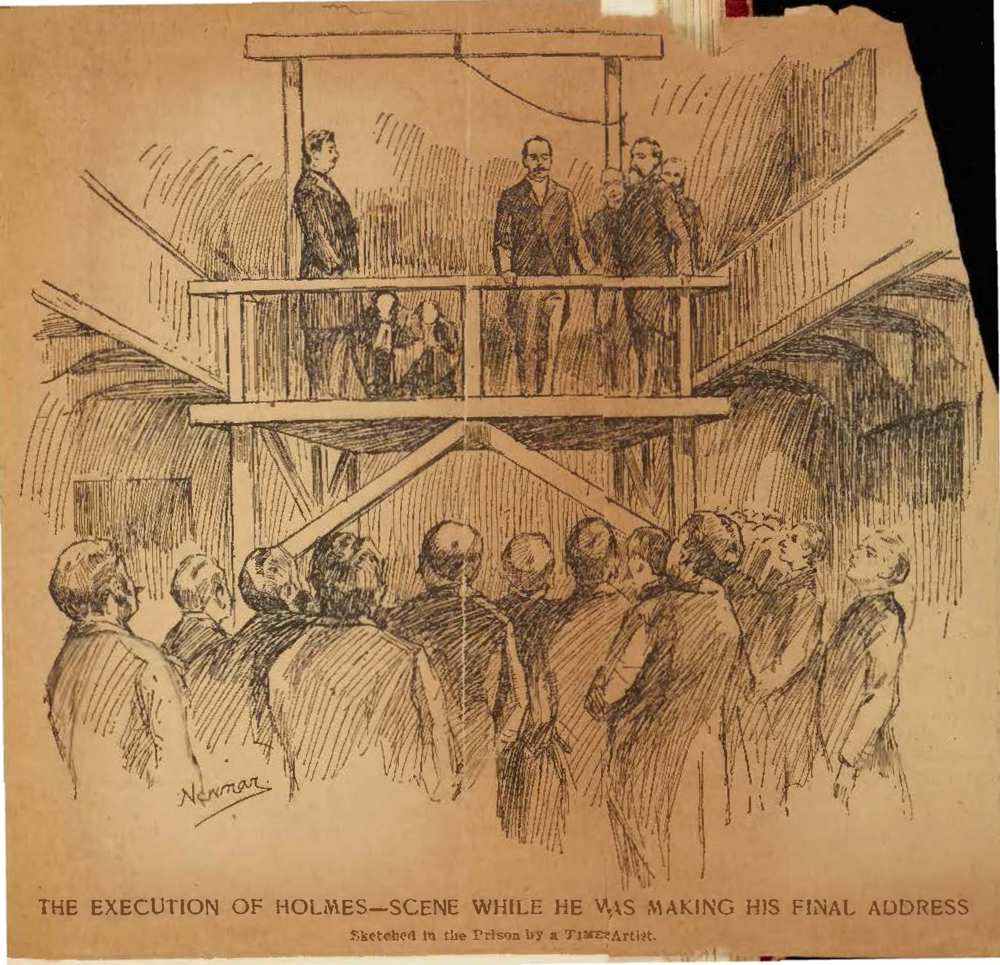
Holmes was convicted of multiple murders and hanged at the Illinois State Penitentiary on May 7, 1896. During his trial he confessed to twenty-seven killings, though the true toll of his victims was never fully established.
Why is H. H. Holmes considered so important in true-crime history?
He is frequently labeled the first serial killer in U.S. history, a designation that gained wide circulation in the 1990s and locked him into the public imagination. His crimes unfolded around the 1893 World's Columbian Exposition in Chicago, which amplified the media frenzy and made his case a landmark in American criminal history.
How many people did H. H. Holmes actually kill?
Holmes admitted to twenty-seven murders, but investigators and later researchers believe the real number was almost certainly higher. The exact count has never been confirmed because of the era's limited forensic tools and the circumstances surrounding his death.
More in Notorious_Criminals_And_Outlaws 1-24
Elsewhere in the Notorious_Criminals_And_Outlaws universe
Spotted an error? Know more?
This is a living reference — every entry is fact-audited, and reader corrections feed straight into our audit queue. Suggest an edit · See this site's audit record