
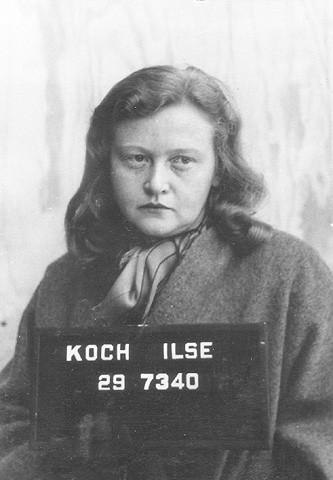
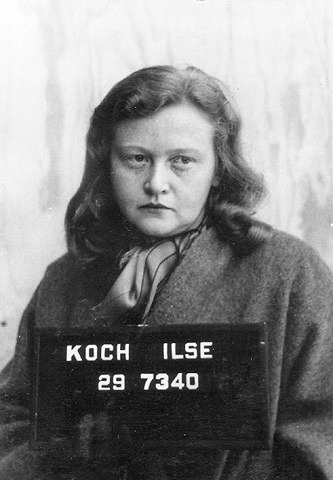
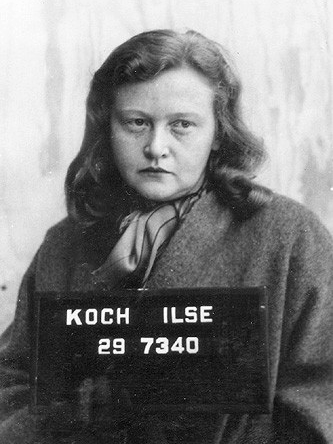
Ilse Koch
German war criminal infamous for alleged atrocities at Buchenwald.

Bernd Schwabe · CC BY-SA 4.0
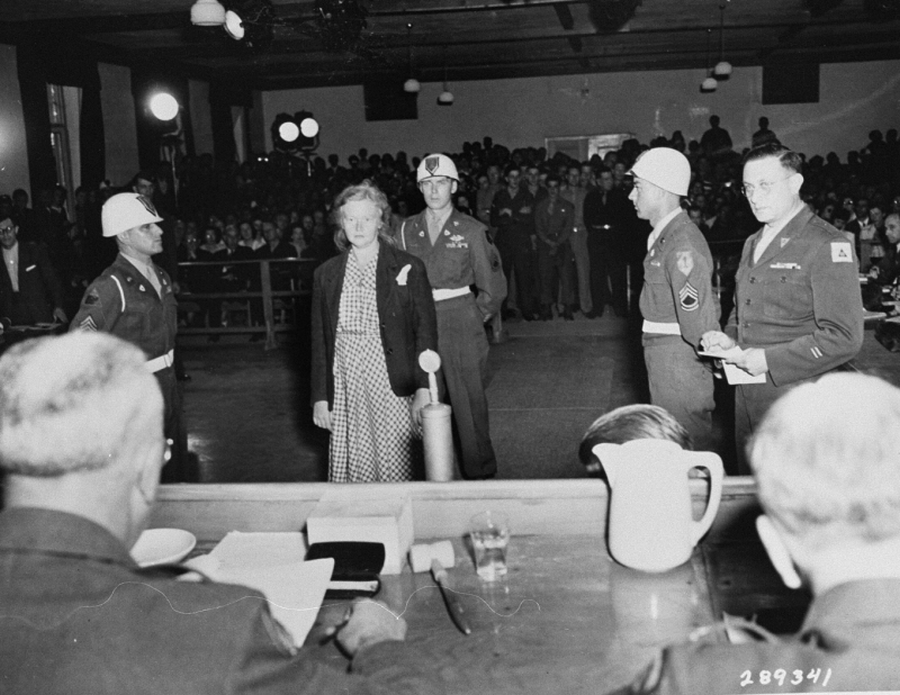
military commission court at Dachau received worldwide media attention due to allegations that she selected prisoners for death to make lampshades and other items from human skin, though these most serious charges were found to lack proof in two separate legal proceedings.
- died
- 1 September 1967, Aichach women's prison, Germany
- field
- War crimes
- nationality
- German
- known_for
- Atrocities at Buchenwald concentration camp; alleged use of human skin for lampshades
Verified Timeline
Lore & Background
After completing elementary and lower secondary schooling, she attended trade school, learned secretarial skills, and worked as a secretary. Following the war, Koch was accused of selecting Jewish prisoners for death to make lampshades and book bindings from their skin. Witness testimony established she used slave labor, assaulted inmates, and reported inmates for beatings that caused death on at least one occasion. However, U.S. Army lawyers reviewing the case found little convincing evidence against her, particularly regarding the skin lampshade charges. She committed suicide by hanging at Aichach women's prison on 1 September 1967.
Reader's Guide
Ilse Koch's significance lies in the stark contrast between her public infamy and the legal findings against her. Despite being branded 'The Beast of Buchenwald' and 'The Bitch of Buchenwald' in media and survivor testimony, two separate legal processes—the U.S. U.S. Army lawyers Harold Kuhn and Richard Schneider noted that 'the record contains little convincing evidence against the accused' and was 'especially silent' on the lampshade charges. This discrepancy between public perception and judicial outcome highlights how wartime atrocity narratives can become entrenched regardless of evidentiary support. Her legacy remains controversial: while she was convicted of participating in the Buchenwald criminal enterprise and was shown to have beaten inmates and used slave labor, the more sensational claims that defined her image were never substantiated in court. Her case continues to serve as a cautionary example of the power of media-driven reputations and the difficulty of separating fact from legend in the history of Nazi war crimes.
Did You Know?
- The most serious allegation—that she ordered prisoners killed for their tattooed skin to make lampshades—was found to be without proof in two separate legal proceedings.
- She committed suicide by hanging at Aichach women's prison on 1 September 1967, at age 60.
- U.S. Army lawyers reviewing her conviction noted that 'the record contains little convincing evidence against the accused.'
Position Across Two Camps
The available record identifies Ilse Koch as a German Nazi who held the position of overseer at two separate concentration camps: Buchenwald and Majdanek. The term overseer denotes a supervisory capacity within the camp hierarchy, placing her in a role of authority over the daily operations and personnel of these sites. That her name is attached to both Buchenwald and Majdanek indicates that her function was not confined to a single location but extended across at least two distinct institutions of the Nazi camp system. This dual association suggests a career that moved between sites, or a period of service spanning both, though the precise timeline and the nature of her duties at each are not detailed in the source material. What is clear from the listing is that her role carried the weight of the Nazi apparatus, and that she occupied a position of oversight rather than mere participation, a distinction that would have placed her within the administrative and supervisory layer of camp management during the period of Nazi control.
Death in a Prison Cell
Ilse Koch's life ended on 1 September 1967, in the manner of hanging, and the location specified is a prison cell. This places her death squarely within the context of post-war detention, more than two decades after the end of the Second World War. The fact that she was in a prison cell at the time of her death indicates she was held in custody, whether awaiting trial, serving a sentence, or in pre-trial confinement, though the source does not specify the legal status she held at that moment. Hanging as the method of death in a confined cell points to a self-administered act, consistent with the broader category of suicides by hanging that the listing encompasses. The date itself, 1 September 1967, anchors her death in the late 1960s, a period when many of the earlier post-war detentions had either concluded or been extended, and when the final chapters of Nazi-era accountability were still unfolding in various jurisdictions.
Among a Cohort of Nazi Detainees
Within the broader listing of notable deaths by hanging, Ilse Koch appears in a dense cluster of German and Austrian Nazi figures who met the same end in prison cells or while in custody. These include SS commandants of extermination and concentration camps, physicians tied to the Nazi euthanasia program, Reich-level officials, and other high-ranking party and military figures. Several of these individuals died in the immediate post-war years of 1945 and 1946, while others, like Koch, persisted in custody into the 1960s. Her placement among this group underscores a recurring pattern: a significant number of those who held positions of authority within the Nazi system ultimately ended their lives by hanging while detained. Koch's inclusion alongside camp commandants, SS officers, and program administrators situates her within the same institutional framework, even as her specific rank and duties differ from those of the others listed.
Notability and Historical Record
The source from which Koch's death is drawn explicitly frames the entries as notable either due to their historical significance or due to media exposure. Koch's inclusion in such a record means that her name and her circumstances crossed into the public historical consciousness, distinguishing her from the countless unnamed individuals who perished in the camps she oversaw or who met violent ends during the war. Her entry sits alongside figures from vastly different fields—poets, physicists, musicians, athletes, politicians, and criminals—united only by the method and notability of their deaths. This juxtaposition highlights how the historical record captures individuals from every stratum of society, and how a Nazi camp overseer can occupy the same categorical space as a rock guitarist or a table-tennis champion. The record does not editorialize; it simply registers the fact of her death, the date, the location, and the method, leaving the full weight of her historical significance to the reader's understanding of the era in which she served.
Gallery


Frequently Asked Questions
What was Ilse Koch's official role at Buchenwald?
She held no formal title or administrative post within the camp or the broader Nazi bureaucracy. Her infamy stemmed from her status as wife of commandant Karl-Otto Koch and her alleged personal involvement in selecting prisoners for execution.
What was the outcome of Ilse Koch's 1947 trial?
A U.S. military commission sitting at Dachau found her guilty on multiple war-crimes counts and handed down a life sentence. She was subsequently transferred into the German prison system, where she remained for the rest of her life.
How did Ilse Koch die?
She died on 1 September 1967 while serving her sentence in a women's prison in Aichach, Germany. She was sixty years old at the time.
More in Notorious_Criminals_And_Outlaws 1-24
Elsewhere in the Notorious_Criminals_And_Outlaws universe
Spotted an error? Know more?
This is a living reference — every entry is fact-audited, and reader corrections feed straight into our audit queue. Suggest an edit · See this site's audit record